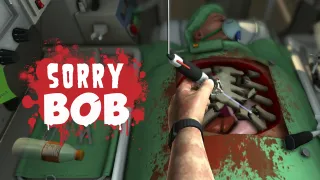
Sorry Bob invites you into a world where control is fragile and certainty lasts only until your next movement.
Gameplay
Early Interactions: Nothing Feels Natural
Your first interactions in Sorry Bob are intentionally uncomfortable. Grabbing an object doesn’t feel like grabbing—it feels like negotiating with weight, momentum, and bad luck. Items tilt when you lift them, rotate when you don’t want them to, and resist being placed exactly where you intend. These early moments are full of hesitation and trial-and-error. You aren’t taught through instructions; you learn by messing up, reacting, and slowly understanding what went wrong.
The Moment It Starts to Click
At some point, usually after several spectacular mistakes, something shifts. You stop trying to force the game to behave and start reading it instead. Movements become more deliberate, pauses more intentional. You begin to anticipate how objects will swing, slide, or tip before they do. Success doesn’t come from precision alone, but from intuition—an understanding of how far is too far, how fast is too fast, and when letting go is smarter than holding on.
Escalation Through Environment, Not Complexity
Rather than piling on new controls or systems, the game increases difficulty by changing the situations around you. Familiar actions suddenly feel harder when the environment shifts or conditions interfere. The mechanics stay the same, but the mental load grows. You’re asked to do what you already know how to do—just under more pressure, with less room for error.
Why Failure Feels Entertaining
In many games, failure is punishment. In Sorry Bob, it’s entertainment. Mistakes are dramatic, exaggerated, and often funny enough to soften the frustration. Because the cost of failure is low, experimentation feels safe. You’re encouraged to try again, not to fix everything perfectly, but to see what happens next.
Every accident becomes a story—something to laugh about, remember, or share. The spectacle turns setbacks into highlights rather than roadblocks.
Sorry Bob leaves a mark because it embraces imperfection and turns it into the core of its gameplay. It doesn’t ask you to be flawless. It asks you to adapt, accept failure, and laugh when things fall apart.
And that’s exactly why it stays with you.
More Simulation Games